
Savings Rate vs Investing Rate: Which One Should You Focus On First?
If you’ve spent any time reading about personal finance, you’ve probably encountered two terms that sound similar but mean very different things: savings rate and investing rate. At first glance, they might seem like the same concept dressed in different words, but understanding the distinction between them and knowing which one deserves your attention first can fundamentally change your financial trajectory. It’s a bit like the difference between gathering ingredients and actually cooking the meal. Both are necessary, but they serve different purposes in your wealth-building journey.
Here’s where many people get stuck: they obsess over investment returns and portfolio optimization before they’ve even established a solid savings foundation. It’s like worrying about which premium fertilizer to use before you’ve planted any seeds. The uncomfortable truth that the financial services industry doesn’t always emphasize is that for most people, especially those just starting out, your savings rate matters far more than your investing rate. But as your wealth grows, that equation shifts. Let’s break down exactly what each term means, why they both matter, and how to prioritize them based on where you are in your financial journey.
Understanding the Core Difference Between Savings and Investing
Your savings rate is straightforward: it’s the percentage of your income that you set aside rather than spend. If you earn $5,000 monthly and save $1,000, you have a 20% savings rate. This metric measures your behavior—how much discipline you have, how effectively you control lifestyle inflation, and whether you’re living below your means. Your savings rate is completely within your control, which makes it both empowering and, frankly, a bit uncomfortable because you can’t blame market conditions or bad luck if it’s too low.
Your investing rate, on the other hand, refers to the percentage return you’re earning on the money you’ve already saved. If you have $100,000 invested and it grows to $108,000 in a year, you’ve achieved an 8% investing rate or return. This metric measures the performance of your invested assets and depends heavily on factors outside your direct control—market conditions, economic cycles, and the specific investments you’ve chosen.
The crucial insight is that these two rates multiply together to determine your actual wealth accumulation. Think of it this way: your savings rate determines the raw material you have to work with, while your investing rate determines how efficiently that material grows. You need both, but their relative importance shifts dramatically depending on your current financial stage.
Why Your Savings Rate Dominates in the Beginning
When you’re just starting your wealth-building journey, your savings rate is overwhelmingly more important than your investing rate, and the math proves it clearly. Let’s say you’re 25 years old and just starting to save. In your first year, you save $6,000. Whether you earn a 5% return or a 10% return on that $6,000, the difference is just $300 versus $600—a $300 gap that, while not nothing, pales in comparison to the difference between saving $6,000 or saving $12,000 in the first place.
This remains true for several years. If you’re consistently saving $10,000 per year, the difference between a 6% return and a 9% return in year three only amounts to about $1,000. But the difference between saving $10,000 versus saving $15,000 that year is, well, $5,000—five times more impactful than squeezing out a few extra percentage points of return.
The reason is simple: when your portfolio is small, even dramatic percentage gains produce modest absolute dollar amounts. A 15% return on $20,000 nets you $3,000. But increasing your savings rate to add another $10,000 to that pool? That’s more than three times the impact. Early in your wealth-building journey, your own contributions dwarf investment returns in terms of actual dollar impact.
This is why so many young investors waste precious energy chasing hot stock tips or agonizing over whether to choose one index fund over another with a 0.05% lower expense ratio. Those concerns aren’t wrong exactly, but they’re dramatically premature. It’s like worrying about aerodynamic optimization when you’re still learning to ride a bicycle.
The Power of Behavioral Control
There’s another crucial advantage to focusing on your savings rate first: you control it completely. You can decide tomorrow to increase your 401(k) contribution by 2%. You can choose to pack lunch instead of eating out, drive your car another two years, or take a cheaper vacation. These decisions directly and immediately improve your savings rate.
Contrast that with your investing rate. You can make smarter investment choices—choosing low-cost index funds over expensive actively managed funds, maintaining proper asset allocation, avoiding panic selling—but you can’t control whether the market goes up or down next year. You can’t will your portfolio to return 12% instead of 6%. The market does what it does, and you’re largely along for the ride.
This control factor makes your savings rate the perfect place to start because you can take action today that produces guaranteed results. Every dollar you don’t spend is a dollar you’ve saved—there’s no uncertainty, no waiting to see how it performs.
When Investing Rate Starts to Matter More
Now here’s where the calculus shifts: as your portfolio grows, investment returns begin to dominate the wealth-building equation. This is the magic of compound growth, and it’s why people who started saving early have such an enormous advantage.
Let’s fast forward to when you have $500,000 saved. At this point, an 8% annual return generates $40,000 in investment gains. Even if you have a stellar 25% savings rate on a $100,000 income, you’re adding $25,000 in new savings that year. The investment returns are now producing more absolute dollars than your savings contributions—and this gap only widens as your portfolio grows.
By the time you have $1 million invested, an 8% return produces $80,000 in gains annually. Unless you’re an extremely high earner with an aggressive savings rate, your investment returns are now contributing more to your net worth growth than your savings. This is the crossover point where optimizing your investing rate becomes increasingly important.
At this stage, seemingly small differences in returns compound into significant dollar amounts. The difference between a 7% return and a 9% return on $1 million is $20,000 annually. That’s real money worth paying attention to—perhaps enough to justify spending time on tax optimization strategies, rebalancing protocols, or evaluating whether your asset allocation still makes sense.
The Right Prioritization Strategy by Financial Stage
Understanding which rate to focus on isn’t an either-or proposition—it’s about appropriate emphasis given your circumstances. Here’s how to think about prioritization across different wealth stages.
Stage 1: Net Worth Under $100,000
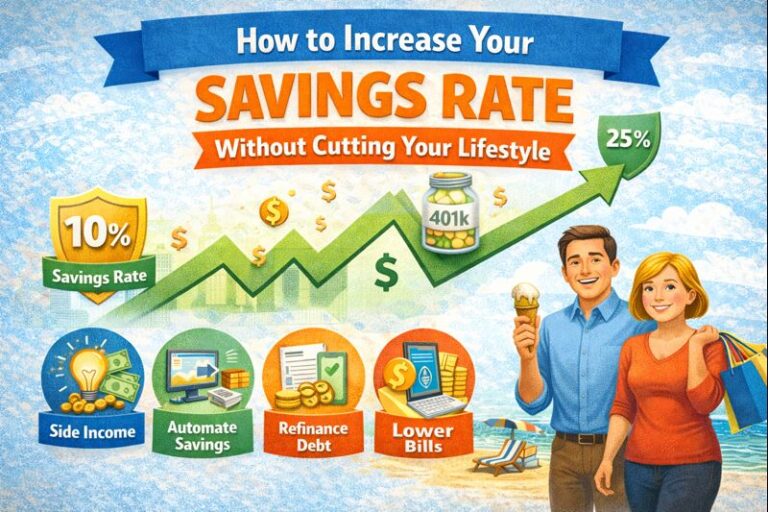
If your investable assets are under $100,000, make savings rate optimization your overwhelming priority. Aim to save at least 15-20% of your gross income, and if you can push that to 25% or 30%, even better. Every percentage point increase in your savings rate will have more impact on your wealth trajectory than any realistic improvement in investment returns.
For your investment strategy at this stage, keep it dead simple. Choose a low-cost target-date fund or a basic three-fund portfolio, automate your contributions, and then largely ignore it. Spend your mental energy on the high-leverage activities: negotiating salary increases, developing valuable skills, controlling expenses, and maximizing your savings rate. The simplest investment approach is fine because you’re not leaving much money on the table even if your strategy isn’t perfectly optimized.
Stage 2: Net Worth Between $100,000 and $500,000
This is the transition zone where both rates deserve attention, though savings rate should still receive primary focus. At this stage, you’ve proven you can save consistently, and now it’s worth ensuring your investment strategy is sound without becoming overly complex.
This is the time to review whether you’re properly diversified, confirm your expense ratios are reasonable (ideally under 0.20% for most holdings), and make sure your asset allocation matches your risk tolerance and timeline. You might also start thinking about tax optimization—are you taking full advantage of Roth conversions, tax-loss harvesting opportunities, or proper account location strategies?
But even with this increased attention to investments, your savings rate should remain the primary driver. If you can increase your savings rate from 20% to 25% at this stage, you should do that before worrying about whether to tilt your portfolio slightly more toward international stocks or small-cap value.
Stage 3: Net Worth Above $500,000
Once you cross the half-million mark, investment optimization deserves significantly more attention. At this level, your portfolio returns are generating substantial absolute dollars, and improving your return by even one percentage point annually can mean thousands or tens of thousands of additional dollars.
This is when it makes sense to consider more sophisticated strategies: tax-loss harvesting, Roth conversion ladders, optimal Social Security claiming strategies, and careful asset location to minimize tax drag. You might also benefit from paying for professional advice since the potential dollar impact of optimization justifies the cost.
However, don’t abandon your savings rate entirely. You should still aim to maintain a strong savings discipline, though you might naturally save less as a percentage of income if you’re approaching retirement and shifting from accumulation to preservation mode.
The Most Common Mistakes People Make
Understanding the savings rate versus investing rate distinction in theory is one thing; applying it correctly is another. Here are the most common ways people get this wrong.
Perhaps the biggest mistake is what I call “fiddling while Rome burns”—obsessing over minor investment optimizations while having a mediocre savings rate. Someone with $30,000 invested who spends hours researching whether to use Vanguard or Fidelity, whether to include emerging markets, or how to shave another 0.03% off their expense ratio while saving only 8% of their income has their priorities completely backward. That time would generate vastly better returns if spent figuring out how to increase their savings rate to 15% or 20%.
The opposite mistake—ignoring investing entirely—is less common but still problematic. Some people achieve impressive savings rates but then leave the money in low-interest savings accounts or money market funds out of fear or ignorance about investing. While a high savings rate is admirable, failing to invest those savings means missing out on compound growth that could literally cost you hundreds of thousands of dollars over a career.
The Timing Trap
Another common error is waiting until you have “enough” saved before you start investing. People tell themselves they’ll start investing once they have $10,000 or $25,000 saved up, but this waiting period means missing months or years of compound growth. The right approach is to do both simultaneously from the start: maintain a high savings rate and immediately invest those savings, even if it’s just $100 or $200 monthly initially.
The flip side is equally problematic: people who feel so overwhelmed by investment decisions that they never start saving at all. Paralysis by analysis keeps them at the starting line while others who chose a simple, “good enough” investment strategy years ago are miles down the road.
Finding the Right Balance for Your Situation
The key to mastering both rates is recognizing that they’re complementary, not competing priorities. Your savings rate gets money into the game, while your investing rate helps that money grow. Early in your journey, focus 90% of your energy on savings rate and 10% on investing rate. As your wealth grows, gradually shift that balance until, in late-stage wealth accumulation, you might be spending 40% of your financial energy on savings and 60% on investment optimization.
Think of it like building a house. In the early stages, you need a lot of raw materials—that’s your savings rate bringing in lumber, concrete, and supplies. The quality of those materials matters somewhat (your investing rate), but having enough materials matters far more. As the house takes shape and you’re doing finish work, the quality and careful placement of materials (investment optimization) becomes proportionally more important, though you still need new materials for ongoing projects.
The most successful wealth builders are those who maintain aggressive savings rates throughout their careers while gradually increasing sophistication in their investment approach as their portfolio grows. They don’t abandon the fundamentals that got them started—living below their means and maintaining savings discipline—but they also recognize when it’s time to evolve their strategy to address the challenges and opportunities of having significant wealth.
Taking Action Today
If you’re reading this and wondering where to focus your energy right now, here’s the simple decision tree: Look at your current savings rate and your current net worth. If your savings rate is below 15% or your net worth is below $100,000, your answer is clear—focus on savings rate first. Optimize your investment approach enough to avoid major mistakes (high fees, poor diversification, panic selling), but keep it simple and spend the majority of your financial energy on saving more.
If your savings rate is above 20% and your net worth is above $250,000, you’ve earned the right to spend more time on investment optimization. You’ve proven you can do the hard behavioral work of saving consistently, and now you can multiply the impact of that work through smarter investing.
The beautiful thing about this framework is that it removes the confusion and gives you clear priorities. You don’t need to master everything at once. Build your savings habit first, keep your investments simple and automated, and then gradually evolve your approach as your wealth grows and the marginal impact of investment optimization increases. That’s the path to financial success that actually works for most people—not chasing the latest hot investment while failing to build the savings foundation that makes wealth building possible in the first place.