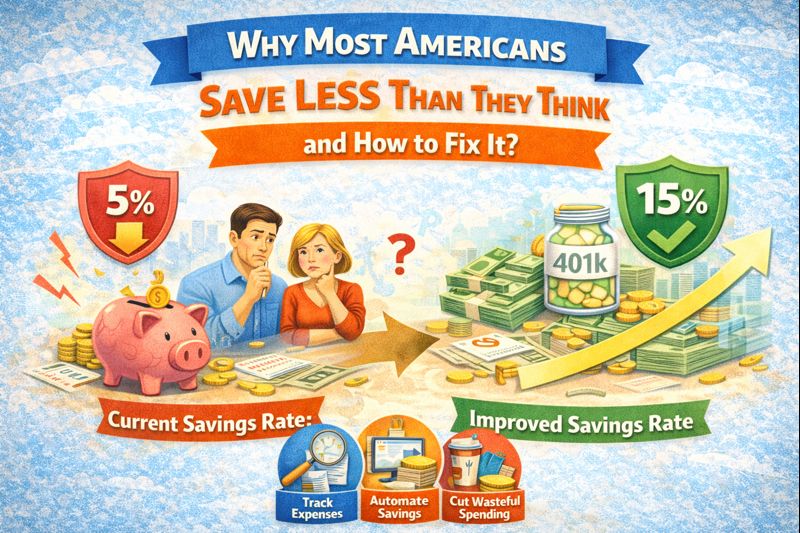
Why Most Americans Save Less Than They Think and How to Fix It?
There’s a strange disconnect happening in American households right now. Ask people if they’re saving enough for the future, and most will say yes or at least that they’re trying. They’ll tell you they’re putting money away regularly, being careful with spending, and making responsible financial choices. Yet when you look at the actual data, the numbers tell a completely different story. The average American household has less than $8,000 in savings, and nearly 40% of Americans couldn’t cover a $400 emergency expense without borrowing money or selling something. So what’s going on? Are people lying about their savings habits, or is something more complicated at work?
The uncomfortable truth is that most Americans genuinely believe they’re saving more than they actually are. This isn’t about dishonesty or delusion it’s about a combination of psychological biases, calculation errors, and structural financial challenges that create a massive gap between perceived savings and actual savings. You think you’re saving $500 monthly when it’s really $200. You believe your savings rate is 15% when it’s actually 6%. You feel like you’re making steady progress toward financial security when in reality you’re barely treading water. Understanding why this happens is the first step toward fixing it, and fixing it is entirely possible once you know what you’re up against.
The Psychological Tricks Our Minds Play on Savings
Our brains are fundamentally terrible at accurately tracking financial behavior over time. This isn’t a character flaw—it’s how human psychology works. Several well-documented cognitive biases conspire to make us overestimate our savings consistently and significantly.
First, there’s what psychologists call the “halo effect” applied to finances. If you made one financially responsible decision recently—maybe you skipped an expensive purchase or transferred $200 to savings—your brain tends to inflate this into feeling like you’re “good with money” generally. That single positive action creates a halo that makes you feel like you’re saving consistently, even if that $200 transfer was the only savings you managed that month.
Then there’s selective memory. We vividly remember the times we saved money because those feel like wins, like accomplishments. But we conveniently forget or minimize the dozen small purchases that eroded those savings. You remember transferring $500 to your savings account last month. You don’t as clearly remember the $80 dinner out, the $45 impulse Target run, the $60 subscription services you don’t use, and the $150 in miscellaneous spending that effectively cancelled out your savings effort.
Present bias compounds the problem. We overweight recent behavior when estimating patterns. If you saved money this week, you assume you’ve been saving all month. If you haven’t dipped into savings this month, you forget about the three previous months when you did. Our brains are simply not designed to accurately track cumulative behavior over time—we’re designed to respond to immediate circumstances.
The Optimistic Accounting Problem
Perhaps most insidiously, we engage in what I call “optimistic accounting.” We count money as saved when we intend to save it, not when we actually do. You plan to save $500 monthly, so when someone asks about your savings rate, you report based on intentions rather than reality. You think “I save $500 a month” even though you only managed it six months out of the last twelve, meaning your actual average was $250.
This isn’t lying—it’s a quirk of how we construct narratives about our own behavior. We see ourselves as the people we’re trying to be rather than accurately assessing what we’re actually doing. And because checking account balances fluctuate and we don’t meticulously track every dollar, it’s easy to maintain these optimistic narratives without ever confronting the hard data that would correct them.
The fix for these psychological issues is brutally simple but uncomfortable: track your actual savings with cold, hard numbers. Not what you intend to save, not what you feel like you save, but what you actually saved. Monthly. In writing. Many people resist this because at some level they know it will reveal an uncomfortable truth. But you can’t fix a problem you won’t measure honestly.
The Math Errors That Inflate Perceived Savings
Beyond psychology, there are specific mathematical errors that cause people to dramatically overestimate their savings rates. These aren’t intentional—they’re honest mistakes that arise from not understanding how to calculate savings correctly.
The most common error is what I call “category confusion.” People add up their 401(k) contribution percentage (maybe 6%), their mental estimate of savings account deposits (perhaps another 5%), and any other saving behavior they can think of, arriving at something like 15-20% total savings rate. But this math is completely wrong because they’re mixing different denominators.
That 6% to the 401(k) is measured against gross income. The savings account deposits are measured against take-home pay. You can’t add a percentage of gross income to a percentage of net income and get a meaningful number. It’s like adding six apples to five oranges and claiming you have eleven apples—the math doesn’t work that way.
Here’s what this looks like in practice: Someone earning $70,000 gross ($4,500 net monthly) contributes 6% to their 401(k) ($4,200 annually) and deposits $200 monthly to savings ($2,400 annually). They think: “6% plus about 4.4% equals roughly 10% savings rate.” But their actual savings is $6,600 annually on $70,000 gross income, which is 9.4%—and that’s if they actually deposited $200 every single month, which they probably didn’t.
The Employer Match Blind Spot
Another massive calculation error is ignoring employer matching contributions. Many people think of their savings rate as just their personal contribution—”I save 6% to my 401(k)”—completely leaving out the 3% or 4% employer match they’re receiving. This makes them think they need to find another 9-10 percentage points to hit a 15% savings rate when they actually only need to find 6-7 more points because they’re already at 9-10% including the match.
This error cuts both ways. It makes people who are actually saving adequately think they’re behind, which could trigger unnecessary lifestyle sacrifices. More commonly, it makes people who aren’t capturing their full employer match unaware of the free money they’re leaving on the table. If you’re contributing 3% when your employer matches up to 6%, you’re effectively rejecting a 100% instant return on another 3% of your salary—yet you might not even realize it if you’re not tracking your total savings rate correctly.
The fix is establishing a consistent methodology for calculating savings rate and using it every single time. Choose gross income as your denominator, count all contributions including employer match, and track it monthly. This removes the mathematical ambiguity that allows inflated estimates to persist.
The Irregular Expense Trap
One of the biggest reasons Americans save less than they think is what I call the “irregular expense trap.” You set up a system where $500 automatically transfers to savings monthly. You see that account growing. You think you’re saving $6,000 annually. But then reality intervenes.
In March, your car needs $800 in repairs—you pull it from savings. In June, you have higher than expected summer travel costs—another $600 from savings. In September, holiday shopping starts early—$400 from savings. In December, property taxes come due—$1,200 from savings. By year end, you deposited $6,000 into savings but withdrew $3,000 for various irregular expenses. Your actual net savings was $3,000, not $6,000, but because you mentally track deposits rather than net accumulation, you still think you saved $6,000.
This pattern is incredibly common. People set up automatic savings transfers and feel good about the deposits, but they don’t track the withdrawals with the same attention. Over a year, these irregular expenses—some planned, some unexpected—significantly erode actual savings accumulation. Yet because the automatic deposits continue, people maintain the perception that they’re saving consistently.
The fundamental problem is that most people don’t properly budget for irregular expenses that are actually predictable. Car maintenance isn’t an emergency—cars need maintenance. Annual insurance premiums aren’t surprises—they happen every year. Holiday gifts aren’t unexpected—December comes around with remarkable regularity. Yet people treat these as emergencies that justify raiding savings, rather than as predictable expenses that should be budgeted separately.
Creating True Savings vs. Expense Buffers
The solution is creating separate buckets for true savings versus expense buffers. True savings goes into accounts you don’t touch except for genuine emergencies or long-term goals. Expense buffers are separate accounts for irregular but predictable expenses—car maintenance, insurance premiums, holidays, home repairs, medical expenses.
Calculate your annual irregular expenses honestly. If you spend $3,000 annually on car maintenance, insurance, gifts, and home repairs, that’s $250 monthly you need to set aside in an expense buffer, not savings. Only money that goes beyond covering these predictable irregulars counts as true savings. This creates uncomfortable clarity about how much you’re actually saving versus just managing cash flow, but that clarity is exactly what you need.
The Lifestyle Inflation Nobody Notices
Here’s a pattern that destroys savings without people realizing it: gradual lifestyle inflation that perfectly consumes all income growth. You get a 3% raise, and somehow your expenses mysteriously grow by 3%. You get a bonus, and within three months it’s completely absorbed into your standard of living. Your income increases by 25% over five years, but your savings rate stays frozen at 8% because lifestyle inflation consumed every penny of growth.
The insidious part is that this inflation happens gradually through dozens of small decisions that each feel reasonable. You upgrade from a studio apartment to a one-bedroom when you get promoted—that’s just adulting, right? You start buying slightly nicer groceries because you can afford it now. You subscribe to a few more streaming services. You go out to dinner one more time per month. Your car lease ends and you get a slightly nicer vehicle because your income has increased.
None of these individual decisions feels like a problem. Each one is justifiable. But collectively, they create a lifestyle that perfectly scales with your income, ensuring you always feel like you’re saving “about the same amount” regardless of how much you earn. The person making $50,000 and saving $4,000 gets promoted to $65,000 and still saves $4,000 because their lifestyle quietly absorbed the entire $15,000 increase.
People think they’re saving more because their absolute savings stayed constant or even increased slightly. But their savings rate—the percentage that actually determines how long until financial independence—stayed flat or even decreased. The trap is that constant or slightly increasing savings amounts feel like progress when they’re actually stagnation or regression once you account for income growth.
The Anti-Inflation Strategy
The antidote is the “split the raise” strategy: when income increases, commit in advance to directing at least 50% of the after-tax increase to savings. Get a raise that adds $300 monthly to your take-home? Increase savings by $150 before you ever see that first paycheck. This prevents lifestyle inflation from automatically consuming income growth while still allowing you to enjoy some benefit from earning more.
The key is making this decision before you experience the higher income. Once you’ve lived with the extra money for a month or two, lifestyle inflation has already started and cutting back feels like sacrifice. But preventing the inflation from happening in the first place doesn’t feel like sacrifice—it feels like maintaining your current lifestyle while smartly managing new income.
The Emergency Fund Illusion
Many Americans believe they have adequate emergency savings when in reality they have emergency spending funds—money that’s designated for savings but gets regularly spent on non-emergencies. This creates a dangerous illusion of financial security that evaporates the moment a real crisis hits.
The typical pattern: Someone has $5,000 in their “emergency fund.” They feel pretty good about this—it’s more than nothing, and financial advice says to have 3-6 months of expenses, so $5,000 seems like progress toward that goal. But over the course of a year, they dip into this fund four or five times. A $600 car repair (not really an emergency, just deferred maintenance). A $400 medical bill (foreseeable given that they need medical care periodically). A $800 home repair (houses need maintenance). A $500 surprise expense for a wedding gift and travel (not an emergency, just poor planning).
Each withdrawal gets mentally categorized as “emergency fund use,” which sounds responsible. But none of these were genuine emergencies—they were predictable expenses that should have been budgeted separately. By year end, the emergency fund is back down to $2,000 despite multiple deposits to rebuild it. This person thinks they have an emergency fund and tells themselves they’re saving, when in reality they have a highly inefficient sinking fund for irregular expenses.
When a real emergency eventually hits—job loss, major medical expense, genuine crisis—the emergency fund is inadequate because it’s been repeatedly depleted for non-emergencies. This person thought they had $5,000 in protection. In practice, they have maybe $2,000, and even that’s at risk of being spent before the real emergency arrives.
Building True Emergency Protection
Create a genuine emergency fund that you define narrowly: job loss, major medical emergency, major home system failure (not maintenance), or similar genuine crisis. This fund should be in a separate account that’s slightly inconvenient to access—not linked to your checking account, requiring a transfer that takes a day or two. This friction prevents impulsive raids for non-emergencies.
Separately, create sinking funds for predictable irregular expenses: car maintenance, medical expenses, home repairs, gifts, insurance premiums. These aren’t savings—they’re deferred spending budgets. Fund them adequately so you’re not constantly raiding your emergency fund, and track them separately so you’re not fooling yourself about how much true savings you have.
Most people who think they’re saving $400 monthly are actually saving $150 while managing $250 in irregular expenses through what they mistakenly call savings. Getting this distinction right transforms your understanding of your actual financial position.
The Retirement Account Out of Sight, Out of Mind Problem
For many Americans, retirement accounts are their primary or only savings vehicle. They contribute to a 401(k), they never see the money, and they assume they’re saving adequately. But they never actually check whether their contribution rate is sufficient, whether they’re capturing their full employer match, or whether their account balance is on track for their retirement needs.
This creates a false sense of security. Someone might be contributing 3% to their 401(k) and assume that’s fine because “at least I’m saving something.” But 3% is nowhere near adequate for retirement—most experts recommend 15-20% including employer match. This person might be 25 years into their career, thinking they’re responsibly saving for retirement, only to discover at age 50 that they’re dramatically behind and facing a retirement crisis.
The problem is that retirement accounts are out of sight—you don’t see the money leave your paycheck in the same visceral way you see money leave your checking account. You get accustomed to your take-home pay, and the 401(k) contribution becomes background noise. You assume it’s adequate without ever checking whether it actually is. Years pass, you think you’re “handling retirement,” and meanwhile you’re not even saving half of what you need.
This is compounded by not understanding total savings rate including employer match. Someone contributing 4% might think they need to increase to 15%, which feels overwhelming—an 11 percentage point increase. But if they’re getting a 5% employer match, they’re actually at 9% and only need to find 6 more points. This is challenging but much more achievable. Not knowing the real numbers leads to either paralysis (it feels impossible so why try) or false confidence (4% sounds like a lot, so I’m probably fine).
The Annual Retirement Check-In
Set a recurring annual calendar reminder to review your retirement savings. Log into your 401(k), check your contribution percentage, verify you’re getting the full employer match, and run your balance through a retirement calculator to see if you’re on track. This takes maybe 30 minutes annually but provides crucial feedback on whether your savings are adequate.
If you’re behind, at least you know it and can make adjustments. If you’re on track, you get the psychological benefit of confirmation. Either way, you’re replacing vague assumptions with concrete data about whether your retirement savings behavior matches your retirement needs. Most people avoid this check-in because they suspect they’re behind and don’t want to confront it. But you can’t fix problems you won’t acknowledge.
The Income Variability Challenge
For Americans with variable income—freelancers, commission-based workers, gig economy participants, or anyone with irregular earnings—saving becomes exponentially harder and tracking becomes nearly impossible. In high-income months, you tell yourself you’ll save the excess. But by the time high-income months arrive, you’ve already spent assuming they would, and the variable income just covers the lifestyle you’ve already inflated into.
The psychological trap is treating high-income months as “catch-up” opportunities while treating low-income months as “survival mode.” In survival mode, you’re not saving anything. In catch-up mode, you’re covering the gap from survival mode plus trying to save. The result is that you never actually get ahead—you’re constantly cycling between deficit and barely-breaking-even, while telling yourself that you’re saving “on average.”
Someone might earn $8,000 in a great month and $3,000 in a slow month, averaging $5,500 monthly. They think, “My average income is $5,500, I spend about $4,500, so I’m saving $1,000 monthly on average.” But in reality, the $3,000 months require dipping into any accumulated savings, and the $8,000 months go partially to rebuilding the buffer and partially to lifestyle inflation (you feel wealthy this month so you spend more). Net result: little to no actual savings accumulation despite seemingly good average math.
The Variable Income Savings System
The solution is paying yourself a steady salary from variable income. Open a separate “income holding” account where all income lands first. From this account, pay yourself the same amount monthly—maybe 80% of your average monthly income over the past year. This regular amount goes to your checking account and becomes your “salary” that you live on and save from consistently.
High-income months build a buffer in the holding account. Low-income months draw from that buffer. This smooths out the variability and makes consistent savings possible because you’re living on a predictable amount rather than riding the income roller coaster. Most variable-income earners resist this system because they want to celebrate high-income months with increased spending. But that’s exactly what prevents savings accumulation.
How to Fix It: The Complete Action Plan
Understanding why Americans save less than they think is valuable, but only if it leads to action. Here’s a complete plan to fix your savings for real.
Step 1: Calculate Your Actual Current Savings Rate
Spend one hour going through the last twelve months of financial activity. Add up everything you deposited to savings, investment accounts, and retirement accounts. Include employer match. This is your numerator. Your gross annual income is the denominator. Calculate the percentage. This is your real, actual savings rate—not what you think it is, what it actually is.
For most people, this number will be sobering. That’s okay. You need the truth to work with, not comforting illusions.
Step 2: Set Up Separate Buckets
Create distinct accounts for different purposes:
- True emergency fund (3-6 months expenses, touched only for real emergencies)
- Irregular expense buffer (car, medical, gifts, home, insurance)
- Retirement accounts (401k, IRA)
- Short-term savings goals (vacation, down payment, etc.)
- Long-term investment accounts
Stop mixing everything together. Each bucket serves a different purpose and should be funded and tracked separately.
Step 3: Automate Real Savings
Set up automatic transfers that happen before you see the money:
- Increase 401(k) contribution to capture full employer match minimum
- Automatic transfer to investment accounts on payday
- Automatic transfer to real emergency fund until it’s fully funded
- Separate automatic transfer to irregular expense buffer
The amount should be based on your target savings rate, not what’s left over. If your target is 15% and you’re at 7%, close that gap through automation.
Step 4: Implement Split-the-Raise
Make a commitment right now: the next time your income increases (raise, bonus, new job, side income), you will save at least 50% of the increase before you see the first paycheck. Put this in writing. Set a reminder. This single commitment will prevent lifestyle inflation from stealing your income growth.
Step 5: Monthly Reality Check
Once monthly, spend 15 minutes checking:
- Did automatic savings happen as planned?
- Did you dip into savings for non-emergencies?
- Is your irregular expense buffer adequate?
- What’s your year-to-date actual savings amount?
This monthly check-in keeps you honest about actual behavior versus intended behavior. It catches problems while they’re small rather than letting them compound for months or years.
Step 6: Annual Deep Review
Once annually, calculate your full savings rate including all contributions and all withdrawals. Compare to your target. Adjust as needed. Review retirement account balance versus target. Make concrete decisions about any needed changes.
This annual review ensures you’re making real progress, not just assuming you are. It’s the difference between genuine financial management and financial wishful thinking.
The Truth That Sets You Free
Most Americans save less than they think because of a perfect storm of psychological biases, mathematical errors, lifestyle inflation, and inadequate tracking systems. But here’s the empowering truth: once you understand these problems, fixing them is entirely within your control. You don’t need a higher income. You don’t need perfect willpower. You need honest measurement, separate buckets, automation, and regular reality checks.
The gap between what you think you’re saving and what you’re actually saving might be uncomfortable to discover. But that discomfort is productive—it’s the discomfort that leads to change. Every person who’s achieved financial security started by confronting the honest truth about their current situation, even when that truth was disappointing. You can’t navigate to a destination if you don’t know where you’re starting from.
Calculate your real savings rate this week. Set up proper buckets and automation. Commit to split-the-raise. Start doing monthly reality checks. These actions will close the gap between perception and reality, and once perception matches reality, you can start making real, lasting progress toward financial security. The question isn’t whether Americans can save—it’s whether they’re willing to face the truth about current savings and take concrete action to improve it. That choice is yours to make.