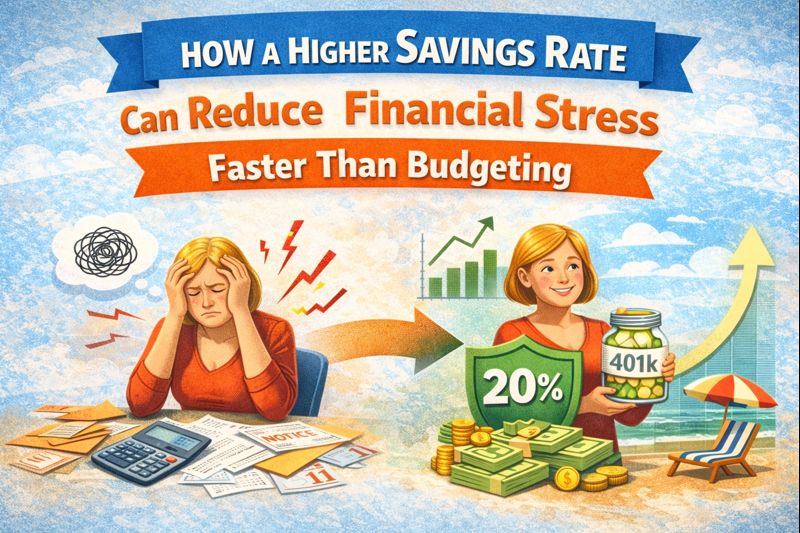
How a Higher Savings Rate Can Reduce Financial Stress Faster Than Budgeting?
Let’s be honest about something most personal finance experts won’t admit: traditional budgeting is exhausting. You know the drill track every single expense, categorize your coffee purchases, feel guilty about that impulse buy, and somehow stay within arbitrary spending limits you set three months ago when you were feeling particularly optimistic about your willpower. For many people, this approach creates more stress than it relieves. You end up feeling like you’re constantly failing at some impossible test, and the financial anxiety just keeps building.
But here’s what changed everything for me and countless others who’ve discovered this approach: focusing on your savings rate instead of obsessive budgeting creates a completely different psychological experience. Rather than tracking where every dollar goes, you focus on one simple metric what percentage of your income you’re keeping. Hit your savings rate target, and the rest takes care of itself. It sounds almost too simple, but this shift from micromanaging expenses to maximizing savings creates a profound reduction in financial stress, and it happens faster than you might think possible.
Why Traditional Budgeting Creates More Stress Than It Solves
Traditional budgeting operates on a scarcity mindset. You’re constantly thinking about what you can’t have, what you shouldn’t buy, and where you went over budget last month. It’s financial restriction that feels a lot like dieting—sustainable for a few weeks, maybe even months, but eventually the willpower runs out and you’re back where you started, now with an extra layer of guilt and failure.
The psychological toll is real. Every spending decision becomes a moment of potential failure. Did you stay within your $200 grocery budget this week? Should you feel bad about that $40 dinner with friends? Is buying that book going to derail your entire financial plan? The mental energy required to constantly police your own spending decisions is enormous, and for most people, it’s simply not sustainable long-term.
There’s also the complexity problem. Life doesn’t fit neatly into budget categories. Is that new pair of work shoes a clothing expense or a professional development expense? When your categories overflow in one area, do you borrow from another? What about irregular expenses that don’t occur every month? The more detailed your budget, the more decisions you need to make, and decision fatigue is a real phenomenon that depletes your mental resources.
Perhaps most problematically, traditional budgeting often focuses on small, daily expenses while ignoring the big picture. You’ll stress about your $5 latte while not addressing the fact that your housing costs 40% of your income or that you’re driving a car with a $600 monthly payment. It’s like rearranging deck chairs on the Titanic—you’re busy, you’re following the rules, but you’re not actually solving the fundamental problem.
The Liberation of the Savings Rate Approach
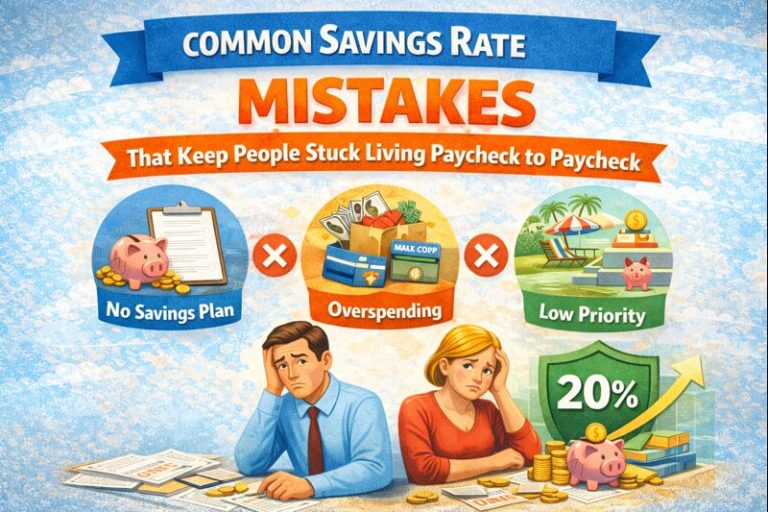
Now imagine a completely different approach. On the first day of the month, you automatically transfer 20% of your income to savings and investment accounts. That’s it. That’s the only number you need to hit. Everything else—how you spend the remaining 80%—is yours to manage without guilt, without tracking, without categorization.
This is the savings rate approach, and it flips traditional budgeting on its head. Instead of tracking where money goes, you focus on what you keep. Instead of restriction and rules, you get clarity and simplicity. Instead of feeling like you’re constantly failing, you either hit your savings target or you don’t—and if you don’t, the solution is clear and actionable.
The psychological shift this creates is profound. You’re no longer operating from scarcity; you’re operating from abundance. You’ve already paid yourself first. The money in your checking account is truly yours to spend however you want. No guilt, no tracking, no second-guessing whether you can afford something. If the money’s there after you’ve hit your savings rate, you can spend it.
This approach respects human psychology in a way traditional budgeting doesn’t. We’re not wired for constant surveillance of our own behavior. We are wired to understand simple rules and clear targets. “Save 20% of every paycheck” is a rule so simple a child could understand it. “Stay within seventeen different spending categories that may or may not accurately reflect your actual spending patterns” is a recipe for burnout.
The Automatic Pilot Advantage
The real magic happens when you automate your savings rate. Set up automatic transfers that occur the day after your paycheck hits your account. Your 401(k) contribution comes out before you even see the money. Your IRA contribution transfers automatically. Your high-yield savings account gets its monthly deposit without any action on your part.
Once automation is in place, you’ve removed willpower from the equation entirely. You’re not choosing to save every month; it just happens. This is crucial because willpower is a finite resource. Every decision you make depletes it slightly. By automating your savings rate, you preserve that willpower for other important decisions in your life while still hitting your financial goals.
The stress reduction here is immediate and tangible. You’re no longer facing daily temptation or daily decisions about whether to save or spend. The decision was made once, months or years ago, and now it executes automatically. This is how you build wealth without thinking about it constantly, which is exactly the opposite of budgeting’s demand for constant vigilance.
How Savings Rate Addresses the Root Causes of Financial Stress
Financial stress doesn’t come from spending $8 on lunch instead of $6. It comes from deeper, more fundamental concerns: Will I be okay if I lose my job? Can I handle an unexpected expense? Am I making progress toward financial security? Will I ever be able to retire? Traditional budgeting rarely addresses these root causes directly. The savings rate approach does.
When you maintain a 20% savings rate, you’re automatically building an emergency fund. Three to six months of expenses don’t feel like an impossible goal—they’re the natural result of consistently saving. This emergency fund is the single most effective stress-reducer in personal finance because it transforms potential disasters into mere inconveniences. Car breaks down? Annoying, but you have the money. Medical bill arrives? Unpleasant, but manageable. This buffer eliminates the constant low-level anxiety of living paycheck to paycheck.
The savings rate approach also creates visible progress toward long-term goals. Every month, you can see your retirement accounts grow, your investment portfolio increase, your net worth climb. This positive feedback loop is psychologically powerful. You’re not just restricting yourself and hoping it works out someday; you’re watching your financial security improve in real-time. Each monthly statement is a small victory, reinforcing the behavior and making it easier to maintain.
The Time Horizon Shift
Perhaps most importantly, focusing on savings rate shifts your time horizon from short-term to long-term thinking. Budgeting keeps you trapped in the present: did you stay within limits this week, this month? Savings rate orients you toward the future: are you on track to reach financial independence, to retire comfortably, to achieve your long-term goals?
This temporal shift reduces stress because it helps you see past temporary discomfort or sacrifice. Yes, saving 25% of your income means living on less today. But you’re not doing it because you should or because some budget says so. You’re doing it because you can clearly see the finish line: financial independence in 20 years, retirement at 55, the ability to take a year off work without financial catastrophe. The sacrifice has purpose and direction, which makes it psychologically sustainable.
Real-World Examples of Stress Reduction Through Savings Rate Focus
Let me walk you through what this looks like in practice, using three real scenarios that illustrate how the savings rate approach reduces stress faster than traditional budgeting.
Example 1: The Young Professional Breaking Free
Sarah is 28, earning $60,000 annually. She spent six months trying traditional budgeting—tracking every expense in an app, setting strict category limits, feeling guilty every time she went over. Her financial stress was actually higher than before she started budgeting because now she was constantly aware of every “failure.”
She switched to a savings rate approach: 20% of her gross income automatically goes to savings and investments ($1,000 monthly), leaving her with roughly $3,000 to spend after taxes and savings. Within two months, her stress dropped noticeably. She stopped opening her budgeting app five times daily. She enjoyed dinner with friends without calculating whether it would blow her restaurant budget. Most importantly, she could see her emergency fund growing steadily—after six months, she had $6,000 saved, providing a buffer that made every day feel less precarious.
The breakthrough came when her car needed a $1,200 repair. In her budgeting days, this would have triggered panic and guilt—she’d blown multiple monthly categories in a single day. With her savings rate approach, she simply paid for it from her emergency fund, then continued her normal savings routine. The fund would rebuild itself over the next few months. No stress, no drama, no need to rework her entire financial plan.
Example 2: The Mid-Career Couple Finding Balance
Marcus and Jennifer, both 41, have two kids and a household income of $140,000. They tried detailed budgeting multiple times over the years and always abandoned it within a few months. The tracking was too tedious, they disagreed about categories, and coordinating two people’s spending made everything exponentially more complicated.
They adopted a 22% savings rate target—approximately $2,600 monthly going automatically to 401(k)s, IRAs, and a 529 plan for the kids. Their remaining take-home pay handles all expenses without tracking individual categories. This simplified approach immediately reduced a major source of tension in their relationship. No more arguments about whether Marcus overspent on golf or whether Jennifer’s shopping trips were within budget. If the money’s in the checking account after savings are handled, it’s free to spend.
The stress reduction became most apparent during an unexpected job loss. Marcus was laid off, but because they’d maintained their 22% savings rate for three years, they had substantial emergency funds. They temporarily dropped to a 10% savings rate during the job search, using the difference to cover expenses. There was stress, certainly, but it was manageable stress—concern about finding a new position, not panic about immediate survival. When Marcus found a new job four months later, they simply resumed their 22% rate without missing a beat.
Example 3: The Late Starter Playing Catch-Up
David is 52 and spent most of his career not thinking much about saving. He tried implementing a detailed budget at 50 but found it overwhelming and discouraging—tracking decades of bad habits felt like facing an impossible mountain to climb. After three months, he’d given up entirely.
His financial advisor suggested a different approach: start with whatever savings rate feels achievable, then increase it by 1% every six months. David began at 12%, which felt manageable even though it was below the recommended 25-30% for his age. The simplicity—just one number to hit—made it psychologically feasible when detailed budgeting had felt impossible.
What surprised David was how quickly his financial stress decreased despite starting with a “too low” savings rate. Even at 12%, he was building his retirement accounts for the first time in years. Every quarterly statement showed progress. After a year, he voluntarily increased to 15%, then 18% six months later. Two years in, he’s at 22% and feels more financially secure at 54 than he did at 50, despite earning essentially the same salary. The key was that simple, achievable framework that created success instead of constant failure.
The Science Behind Why This Works
The effectiveness of the savings rate approach over traditional budgeting isn’t just anecdotal—it’s rooted in behavioral psychology and how our brains actually work.
Humans are terrible at monitoring multiple variables simultaneously. Research in cognitive psychology shows that we can effectively track about three to four things in our working memory at once. A detailed budget might have fifteen or twenty categories, which exceeds our cognitive capacity. The result is mental fatigue and eventual abandonment of the system. A savings rate is one number—well within our cognitive limits.
We’re also much better at formation of new habits through simple, consistent actions than through complex decision trees. “Save 20% of every paycheck” is a simple habit. “Evaluate every purchase against current category balances while adjusting for irregular expenses and reconciling joint spending decisions” is not a habit—it’s a part-time job.
The Positive Reinforcement Loop
The savings rate approach creates what psychologists call a positive reinforcement loop. Every month, you see your net worth increase, your emergency fund grow, or your retirement accounts expand. This visible progress releases dopamine, the same neurotransmitter associated with achievement and pleasure. Your brain literally rewards you for the behavior, making it easier to maintain.
Budgeting, by contrast, often creates negative reinforcement loops. You go over budget, feel guilty, promise to do better, go over budget again. Even when you stay within budget, the reward is simply… not feeling bad. You’re avoiding a negative rather than achieving a positive. The psychological impact is dramatically different.
Research on financial stress shows that the perception of progress matters as much as or more than absolute financial position. Someone with $10,000 saved who’s consistently adding $500 monthly feels less financial stress than someone with $15,000 saved who isn’t adding anything. The savings rate approach maximizes this sense of progress and momentum, which directly reduces anxiety and stress.
Combining Savings Rate with Conscious Spending
Now, I’m not suggesting you should be completely thoughtless about spending. The savings rate approach works best when combined with what I call “conscious spending”—being intentional about your major financial decisions while not sweating the small stuff.
The big three expenses—housing, transportation, and food—typically account for 60-70% of most people’s spending. Get these right, and everything else tends to fall into place. If your housing costs 25% of your income instead of 40%, if you drive a reliable used car instead of a new luxury vehicle, and if you grocery shop strategically while occasionally dining out, you’ll probably hit your savings rate target without tracking every dollar.
This is where the savings rate approach shows its elegance. You don’t need to micromanage your spending—you just need to make good decisions on the big stuff and avoid truly destructive financial behaviors like high-interest debt or lifestyle inflation every time you get a raise. Keep your major expenses reasonable, automate your savings, and the rest takes care of itself.
The Monthly Check-In
While you’re not tracking daily expenses, a simple monthly check-in keeps you accountable without creating stress. Once a month, ask yourself three questions: Did I hit my savings rate target? Is my emergency fund adequate? Are my major expenses (housing, transportation, insurance) still reasonable relative to my income?
If the answer to all three is yes, you’re doing fine. Spend the rest of your money however you want without guilt. If the answer to any is no, you have clear, actionable information about what needs adjustment. This monthly check-in takes perhaps fifteen minutes and provides all the financial oversight most people actually need.
Making the Switch From Budgeting to Savings Rate
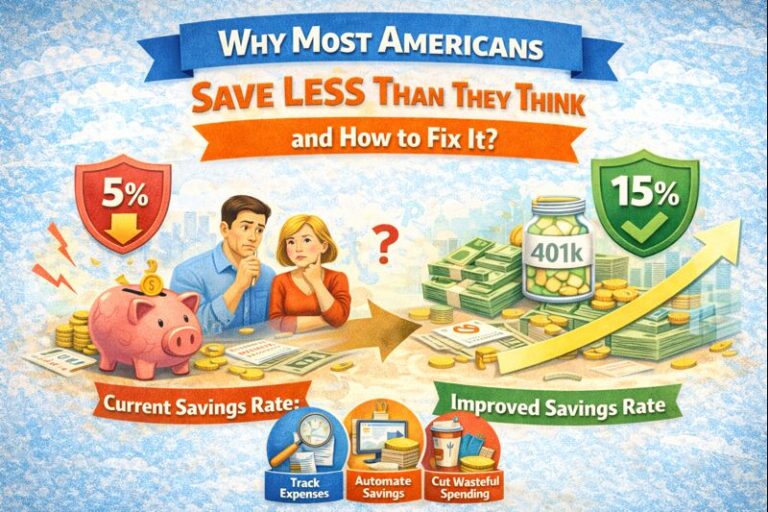
If you’re currently trapped in the budgeting stress cycle, transitioning to a savings rate approach is simpler than you might think. Start by calculating your current savings rate—what percentage of your gross income are you actually keeping? For many people, this number is sobering, but it gives you a baseline.
Next, set a target savings rate that’s achievable but meaningful. If you’re currently saving 5%, jumping immediately to 25% probably isn’t realistic. Try 10% or 12% instead. Remember, the goal is to create a sustainable system, not to achieve perfection overnight. You can always increase your rate later once the habit is established.
Automate everything you possibly can. Set up automatic transfers to savings accounts, investment accounts, and retirement plans. The money should disappear before you have a chance to spend it. This removes the daily willpower requirement and makes savings effortless.
Finally, give yourself permission to stop tracking daily expenses. This might feel uncomfortable at first—you’ve been trained to believe that financial responsibility requires constant vigilance. It doesn’t. If you’re hitting your savings rate and your major expenses are reasonable, you’re already in better shape than the vast majority of detailed budgeters who eventually abandon the practice entirely.
The transition period might take two or three months as you adjust to the new approach and ensure your savings rate is sustainable given your spending patterns. But most people report feeling noticeably less financial stress within the first month, and dramatically less stress within three months. The mental relief of not tracking every transaction, not feeling guilty about normal spending, and seeing consistent progress toward financial goals creates a completely different emotional relationship with money.
Financial stress doesn’t come from spending money—it comes from uncertainty, lack of progress, and constant feelings of failure. The savings rate approach addresses all three directly, creating a clear path forward that feels achievable rather than overwhelming. That’s why it reduces stress faster than traditional budgeting ever could.